
Imagine coming to a stop at a red light. You press the brake, and your car’s wheels are completely stationary. However, under the hood, the engine is still humming along, spinning at roughly 800 revolutions per minute. If the engine is spinning but the wheels are stopped, something must be severing the connection between the two.
The essential components responsible for gracefully engaging and disengaging this flow of power are the ‘Clutch’ in a manual transmission and the ‘Torque Converter’ in an automatic.
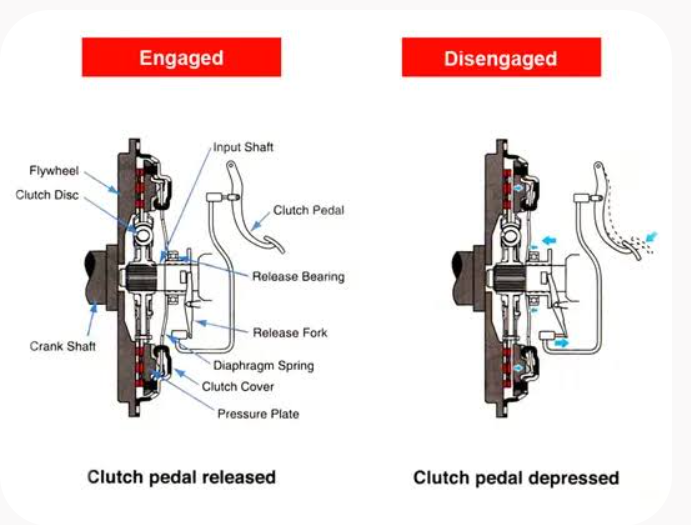
Manual Transmission: The Honest and Direct ‘Clutch’
In a vehicle with a manual transmission (stick shift), the driver physically disconnects the engine from the wheels by stepping on the clutch pedal with their left foot. The underlying principle is surprisingly simple: pure physical friction.
Attached to the engine is a spinning metal disc (the flywheel). Attached to the transmission is another disc (the clutch disc). When you take your foot off the pedal, heavy springs clamp these two discs tightly together, forcing them to spin as one solid unit. When you press the pedal down, the pressure is released, and the discs separate just enough to stop transferring power.
Because it relies on a direct metal-to-metal connection, a manual clutch transfers virtually 100% of the engine’s power to the wheels. It’s highly efficient and engaging to drive. The downside? If you are stuck in brutal stop-and-go commuter traffic, working that heavy pedal hundreds of times will give your left leg a serious workout.
Automatic Transmission: The Fluid Magic of the ‘Torque Converter’
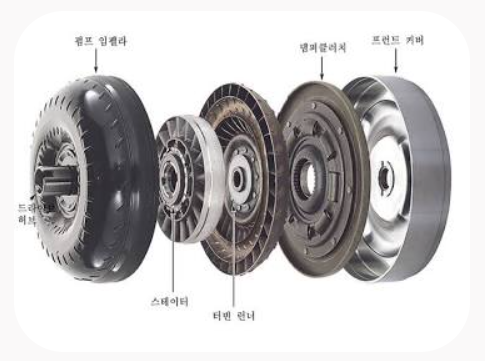
The automatic cars most of us drive today do not have a clutch pedal. In its place is a heavy, donut-shaped device called a torque converter. Unlike the manual clutch that clamps down physically, a torque converter transfers power using fluid (transmission oil).
The easiest way to understand this is to picture two electric desk fans facing each other. If you turn one fan on high speed, the wind it generates will eventually cause the blades of the unplugged fan opposite to it to start spinning. A torque converter works on this exact same principle, but instead of air, it uses thick, pressurized transmission fluid churning in a sealed housing. Because the connection is fluid rather than solid, pulling away from a stop is incredibly smooth, and it’s virtually impossible to stall the engine.
Technological Evolution: The “Inefficient Automatic” is a Myth Today
Decades ago, it was a universally accepted fact that manual cars got much better gas mileage than automatics. This was true because torque converters inherently lost power while churning all that fluid—the engine might produce 100 horsepower, but only 80 made it to the wheels.
Today, the story is entirely different. Modern torque converters feature a “Lock-up Clutch.” Once the car accelerates and reaches a steady cruising speed, this internal clutch mechanically locks the engine and transmission together, entirely bypassing the fluid connection for zero power loss. Combine this with modern transmissions boasting 8 or 10 gears tightly packed together, and computers that shift in milliseconds, and the debate is over. Modern automatics are now faster, smoother, and more fuel-efficient than manuals.
The Mechanic’s Perspective: Worn Friction vs. Dirty Fluid
Because their designs are so different, they fail and require maintenance in entirely different ways.
In a manual car, every time you shift gears, you are rubbing those friction plates together. Eventually (often around 60,000 to 100,000 miles), the clutch disc simply wears out like a pencil eraser and must be replaced. It is a wear-and-tear consumable item.
An automatic’s torque converter, however, rarely wears out physically because there is no metal-to-metal friction. Instead, its lifeblood is the Transmission Fluid (ATF). If you neglect your fluid changes, the oil degrades, loses viscosity, and becomes contaminated with microscopic metal shavings. This leads to the transmission “slipping” (the engine revs, but the car barely moves) or harsh, clunky gear changes. Don’t blindly trust manuals that claim “lifetime fluid.” Changing the transmission fluid every 50,000 to 60,000 miles is the absolute best insurance policy for saving an automatic transmission that costs thousands of dollars to replace.
