
If you’ve ever pumped up a bicycle tire, you probably remember the feeling of resistance and pressure as you pushed the handle down. Deep inside a car’s engine, this exact same physical process happens thousands of times a minute—only accompanied by violent, controlled explosions. This is the domain of the ‘Cylinder’ and the ‘Piston,’ the indisputable heart of the internal combustion engine where the fundamental power to move your car is born.
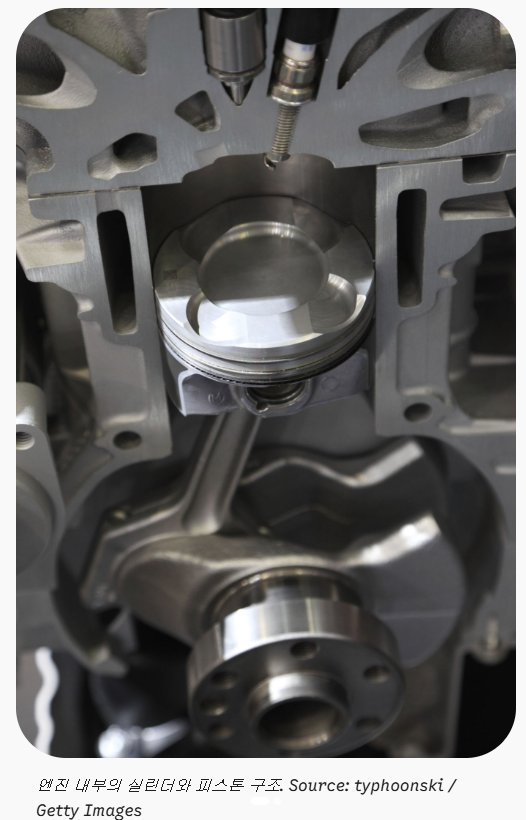
The Magic Chamber That Turns Explosions into Motion
The Cylinder is essentially a hollow tube (think of the barrel of a syringe), and the Piston is a solid, cylindrical piece of metal that slides tightly up and down inside it (like the rubber plunger).
In a typical 4-stroke engine, the piston performs a relentless, four-part dance:
- Intake: The piston moves down, sucking a mixture of air and fuel into the cylinder.
- Compression: The piston moves back up, heavily compressing the mixture into a tight space.
- Combustion (Power): A spark plug ignites the pressurized mixture (or it self-ignites under pressure in diesel engines). The resulting massive explosion forces the piston violently downward. This specific downward stroke is what generates the actual power that eventually turns your wheels.
- Exhaust: The piston rises once more, pushing the burnt gases out of the cylinder through the exhaust valve.
Technological Evolution: From Heavy Iron to High-Tech Alloys
In the past, cylinder blocks and pistons were predominantly cast from iron. They were incredibly heavy, but the primary goal was sheer durability—surviving the immense heat and pressure of constant internal explosions. However, a heavy engine ruins fuel economy and makes a car handle sluggishly.
The recent technological trends focus entirely on lightweighting and friction reduction. Modern engines rely heavily on advanced aluminum alloys for both the cylinder block and the pistons, drastically reducing weight while improving heat dissipation. Because aluminum is softer than iron, engineers now apply microscopic, ultra-hard coatings (like Nikasil or Plasma-transferred wire arc spraying) to the cylinder walls to ensure longevity. Furthermore, modern pistons often feature Diamond-Like Carbon (DLC) or special Teflon-based coatings on their skirts (sides) to minimize friction as they travel up and down at blistering speeds.
Additionally, with the rise of Gasoline Direct Injection (GDI) engines, the top of the piston (the crown) is rarely flat anymore. Engineers design complex, contoured shapes into the piston crown to manipulate the incoming air and injected fuel, creating specific swirl patterns for the most efficient combustion possible.
The Expert’s Perspective: Minding the Gap
There is a microscopic gap between the piston and the cylinder wall—essential for the piston to move freely, but detrimental if combustion gases escape through it. This gap is sealed by piston rings fitted around the piston.
When vehicle owners neglect their oil changes, these rings suffer. They can wear out prematurely or get stuck due to carbon buildup. When the seal fails, highly pressurized combustion gases blow past the rings into the bottom of the engine (the crankcase)—a phenomenon known as “blow-by.” This results in a severe loss of horsepower, decreased fuel efficiency, and rapid engine oil consumption. This is exactly why regular oil changes are the single most critical maintenance task: to keep these rings lubricated, minimize metal-to-metal friction, and maintain the engine’s vital compression seal.
