
In a car, the critical component tasked with safely delivering the engine’s explosive rotational force to the wheels is known as the Drive Shaft.
Depending on whether that power needs to go to the front wheels, the rear wheels, or all four simultaneously, the skeletal structure of this “spine” changes dramatically.
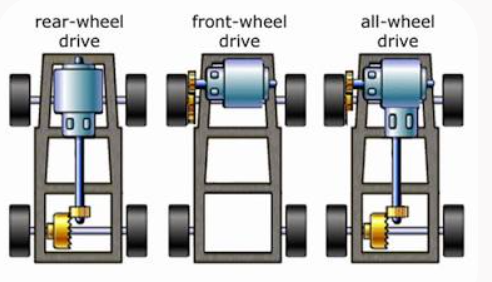
Front-Wheel Drive (FWD): The Practical ‘Short Legs’
The vast majority of modern sedans and compact SUVs utilize a Front-Engine, Front-Wheel Drive (FF) layout. Because the engine, transmission, and driven wheels are all crammed tightly together at the front of the car, there is absolutely no need for a long spine running down the length of the vehicle. Instead, the transmission simply shoots power straight out to the left and right front wheels using two short shafts (half-shafts equipped with CV joints).
This layout is a miracle for practicality. Without a bulky shaft running underneath, the cabin floor can be flat, creating a massive amount of interior space. Fewer heavy parts also mean better fuel economy. However, because all the weight and mechanical workload are concentrated at the front, handling dynamics during aggressive cornering or hard acceleration can feel slightly unbalanced.
Rear-Wheel Drive (RWD): The Long Spine for Perfect Balance
Luxury sedans (think BMW and Mercedes) and true sports cars obstinately stick to the Front-Engine, Rear-Wheel Drive (FR) layout. To get the power from the engine up front all the way to the back wheels, the car relies on a long, thick metal tube running straight down the middle of the chassis—the propeller shaft (or driveshaft).
Why bother with this heavy, complex setup? It’s all about weight distribution. By pushing the driving components to the rear, engineers can achieve a perfect 50:50 front-to-rear weight balance. This translates to a buttery smooth ride and handling that feels like the car is glued to the road around corners. The main drawback? That long spine needs space, resulting in the dreaded “transmission tunnel” hump that eats into the legroom of the middle rear passenger.
All-Wheel Drive (AWD): The Web for Ultimate Grip
As the name implies, AWD sends power to all four corners. This requires an extra gearbox called a ‘transfer case’ bolted behind the transmission, which splits the power. The car then utilizes multiple drive shafts running to both the front and rear axles like a mechanical spider web.
While it is the heaviest and most mechanically complex setup, the tradeoff is absolute traction. Whether you are blasting through a snowstorm, navigating a slick, rain-soaked highway, or hitting a muddy trail, the confidence of having all four wheels clawing at the pavement is unmatched.
Technological Evolution: From Heavy Steel to Carbon Fiber and Electrons
Historically, propeller shafts had to endure brutal twisting forces, so they were made of incredibly thick, heavy steel. However, in recent years, high-performance sports cars have begun using drive shafts woven from pure carbon fiber. This cuts the weight in half while actually increasing rigidity, resulting in lightning-fast engine response.
Furthermore, while older AWD systems relied on clunky mechanical gears to split power, modern systems use electronic clutch packs. These high-tech systems read the road surface hundreds of times a second and actively shuttle torque side-to-side and front-to-back (Torque Vectoring) to whichever wheel has the most grip, long before the driver even realizes they are sliding.
The Mechanic’s Reality Check: What’s That Clicking Noise in the Parking Lot?
If you own a Front-Wheel Drive car, here is a crucial maintenance tip. Your front wheels have to do two jobs at once: receive engine power and steer the car. To allow the shaft to bend while still spinning, it uses a highly articulated joint called a CV Joint (Constant Velocity Joint).
These joints are packed with grease and protected by ribbed rubber boots. Over time, the rubber dries out and tears, slinging all the lubricating grease out onto the road. If you are ever maneuvering tightly in a parking lot with the steering wheel cranked all the way to one side, and you hear a rhythmic, metallic “click-click-click” or popping noise coming from the wheel well? That means the rubber boot has torn, the grease is gone, and the metal bearings inside the joint are actively destroying themselves. The next time you get an oil change, simply asking your mechanic to “check the CV boots for tears” can save you from a very expensive axle replacement.
