
Have you ever turned the knob on a gas stove and heard that rapid ‘click-click-click’ followed by a blue flame? No matter how well the gas is flowing, you can’t start cooking without that initial tiny spark. The gasoline engine in a car works on the exact same principle. Even if the cylinder has perfectly compressed the air-fuel mixture, without a decisive ‘spark’ at the precise millisecond, the engine is nothing more than a cold lump of metal. The unsung heroes that create this critical spark are the Ignition Coil and the Spark Plug.
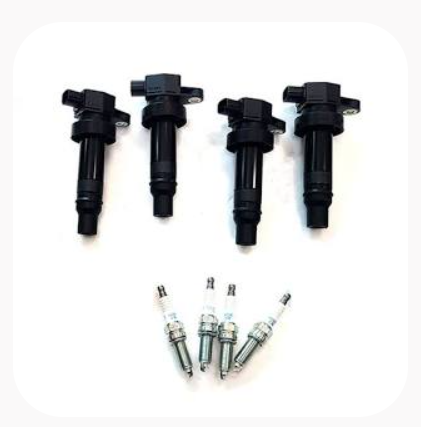
Ignition Coil: The Magical Transformer (12V to 30,000V)
A standard car battery only provides 12 volts of electricity. That is nowhere near enough power to create a spark capable of jumping a gap under the extreme pressure and tight space inside an engine cylinder. Enter the ignition coil.
Essentially a miniaturized electrical transformer, the ignition coil takes that measly 12V and amplifies it into a massive, momentary surge of 20,000 to 40,000 volts. This tremendous energy is absolutely necessary to strike a reliable bolt of miniature lightning inside the harsh environment of the combustion chamber.
Spark Plug: The Lightning Rod Striking Thousands of Times a Minute
The spark plug receives this high voltage from the ignition coil and delivers it directly into the engine cylinder. At the very tip of the spark plug, there is a tiny, precise gap. When the high voltage jumps across this gap, it creates the ‘spark’.
When you’re cruising on the highway, each spark plug fires dozens of times per second, enduring explosive temperatures exceeding 2,000°C (3,600°F) and extreme mechanical pressure. It is arguably the toughest job in the entire engine. (Note: Diesel engines do not have spark plugs because they rely on extreme pressure for spontaneous combustion.)
Technological Evolution: From Distributors to ‘Coil-on-Plug’, From Copper to ‘Iridium’
Decades ago, cars used a single, large ignition coil and a mechanical “distributor” with a spinning rotor to route the electricity to each spark plug via thick, heavy spark plug wires. Today, the modern standard is the ‘Coil-on-Plug’ (COP) system. Now, each individual spark plug has its own dedicated, compact ignition coil mounted directly on top of it. This eliminates power loss through wires and allows the engine’s computer (ECU) to perfectly time the spark down to the millisecond.
The materials used in spark plugs have also seen a massive upgrade. Older nickel-copper plugs needed replacing every 20,000 to 30,000 miles. Modern spark plugs feature center electrodes tipped with precious, highly durable metals like Platinum or Iridium. These advanced materials drastically reduce wear, allowing modern spark plugs to perform flawlessly for 60,000 to 100,000 miles before needing replacement.
The Expert’s Perspective: The Engine’s Diagnostic Doctor
What happens when a spark plug or ignition coil begins to fail? The cylinder fails to ignite the fuel mixture, resulting in unburned fuel being pumped out the exhaust. This is known as an “engine misfire.” If your car vibrates harshly while idling, hesitates or lacks power when you press the gas pedal, or suffers a sudden drop in fuel economy, these two components are the prime suspects.
Professional mechanics can actually diagnose the overall health of an engine just by looking at the tip of a used spark plug. If the tip is a light tan or grayish-brown, the engine is running perfectly. If it is coated in dry, black soot, the engine is running too “rich” (getting too much fuel). If it looks chalky white or blistered, the engine is running dangerously hot or “lean.” Though they are small, they serve as crucial indicators representing the internal health of the entire engine system.
